

Dong Yang is the Best Partner
We promise that we will commit our utmost efforts to develop
new technologies and improve our product quality in a consistent
manner to achieve customer satisfaction.
Dong Yang is the Best Partner
We promise that we will commit our utmost efforts to develop
new technologies and improve our product quality in a consistent
manner to achieve customer satisfaction.
Product
 > Product > Automatic gas purger
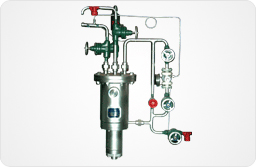
The cooling coil gas purger, which perfectly removes non-condensing gas generated from the refrigeration system, is critical in order to ensure the efficient operation of the refrigeration system.
The non-condensing gas in the refrigeration system is one of the main reasons, which reduces not only the performance but the useful life of major equipment including the condenser. You can achieve efficient system management and reduce energy consumption by using our GP-70 series.
The air generated in the refrigerator increases the condensing pressure, and causes a waste of power, decrease in freezing ability, and accelerated abrasion in the refrigerator. As the highly compressed pressure, which is the sum of the partial pressures of ammonia and air, increases the pressure as much as the amount of air entered, and ammonia gas condensed within the scope of cooling pipe disturbs the heat transfer, the coolant is directly discharged from a vertical condenser despite the increase of high compressed pressure because the coolant can't absorb the heat. As stated above, if the high power increases, the power also increases accordingly despite the deterioration of freezing capability. In other words, the operating costs increase as more axial horsepower per unit freezing capability is required. Therefore, non-condensing gas needs to be purged immediately, or it increases the power ratio and accelerates the abrasion and damage to the machine. If non-condensing gas is spread in the atmosphere (or water) a large amount of ammonia gas is lost.
Since the sum of partial pressure of ammonia and partial pressure of non-condensable gas (hereinafter called "air") is the pressure of the high pressure side, taking out air at the place with low partial pressure of ammonia results in small loss of ammonia.
That is, the place with low temperature is high in the partial pressure of air, and has much air accumulated.

Provide at point A right above the liquid header. Otherwise, provide the connector on the liquid piping right above the place as near as possible to the condenser. If two or more condensers are used, connectors for purging are provided at proper positions of the respective condensers and also at the receiver. However, in the case of above illustration, be sure to open only one of them and never two or more the same time.
If two or more purge pipes are opened, gas flows from the condenser with the highest pressure to the condenser with the lowest pressure, disturbing the air flow in the condenser with the lowest pressure.
- In case of a vertical shell and tube condenser, the first thing to consider is that as the top part, which is the inlet area of coolant, is frequently cooled, the partial pressure of non-condensing gas is high and non-condensing gas is easily gathered. Next, as the temperature of the gas located near the liquid surface right above the liquid outlet at which the super cooled liquid is stagnant is low (including the discharge of air from the liquid receiver), non-condensing gas is easily discharged from this area.

- As ammonia gas also flows along with the liquid in the direction of the liquid receiver and non-condensing gas is stagnant in the liquid receiver if the liquid receiver is installed in a cool area, it is desirable to remove non-condensing gas from the liquid receiver. Removing non-condensing gas from a spot with the lowest temperature in the high pressure sector means that the location where non-condensing gas is discharged (accumulated) in the summer season is different from that in the winter season. The connection port of a gas purger needs to be connected to both the condenser and the liquid receiver. This is considered to be the best way to remove non-condensing gas by selecting appropriate locations and time based on the above mentioned method.


Tel : +82-032-862-4644 Fax : +032-866-7530 E-mail : dyltd@dyltd.co.kr
Copyright 2014 DONG YANG All rights reserved.